I know that it’s been ages since I’ve posted here, but I’ve been super busy with some other great Jewish monster hunting projects. I’m hoping to get back to the blog, but in the meantime I thought I’d share some of these projects.
First, Jewish Monster and Magic Trading Cards!
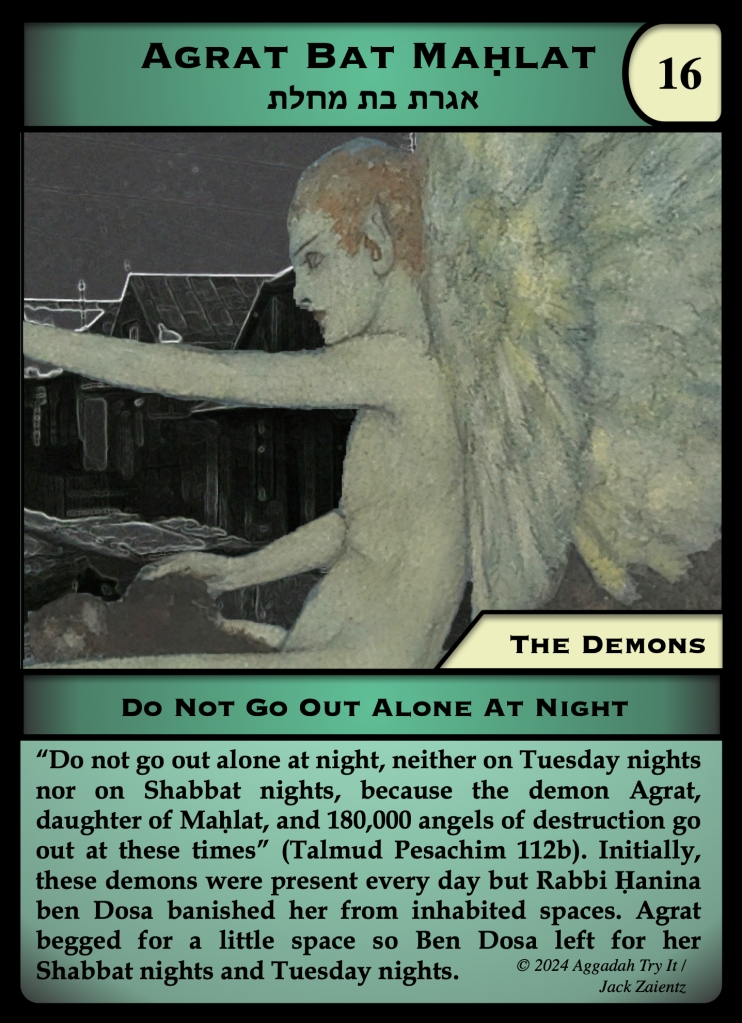
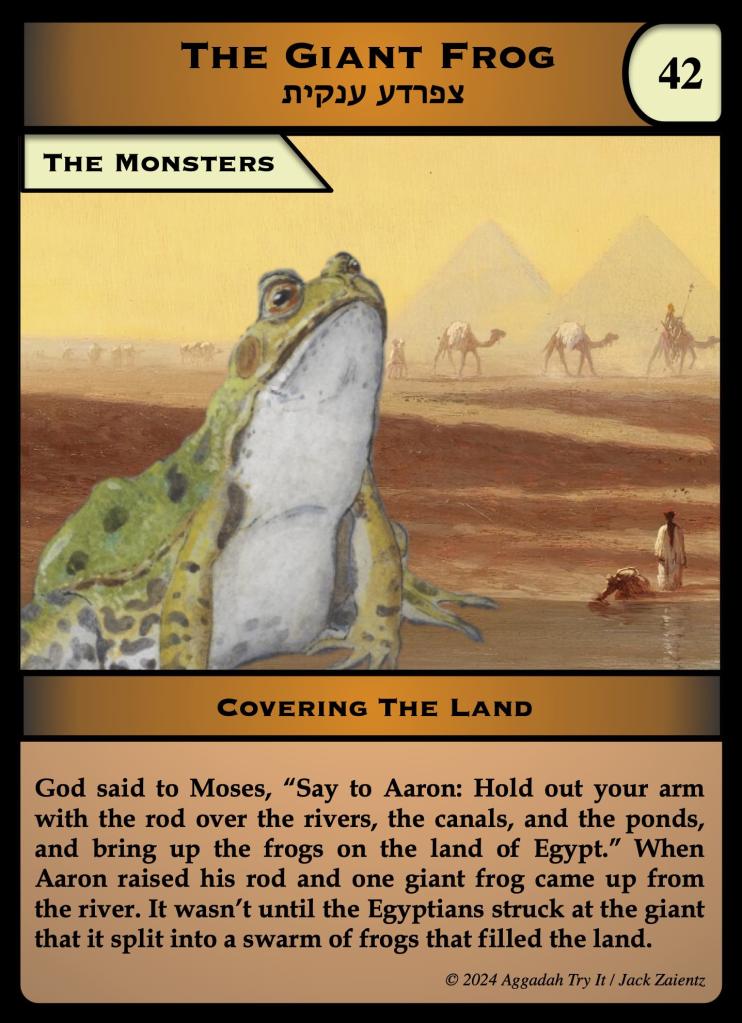
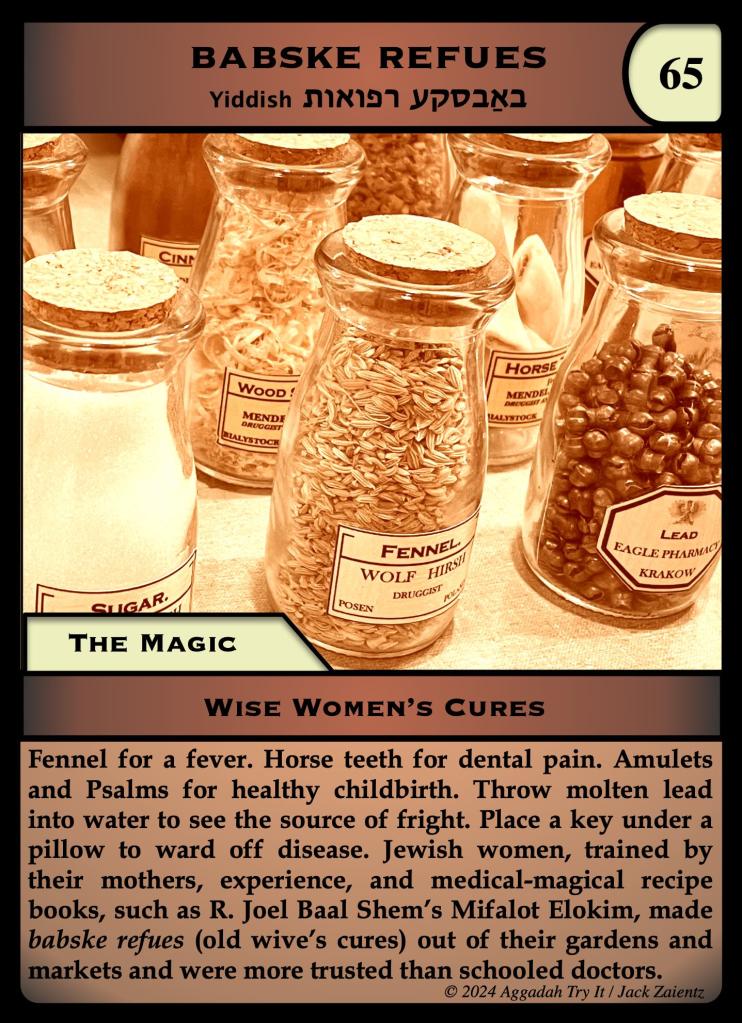
Working with Madness Heart Press / Aggadah Try It, I’ve been busy developing a set of Jewish Magic and Monster Trading Cards that showcases the wildness and richness of Jewish lore. The cards feature a beautiful combination of my original graphics, collage art, and photographs as well as vintage illustrations and public domain images.
Between the two decks, there are 108 individual cards that tell the stories of angels and shedim (demons); giants and sea monsters; rabbinic grimoires and amulets; Jewish women’s home magic rituals and ingredients; and a long list of amazing characters including Yosef Sheyda (Joe the Demon), demon friend to the Rabbis of the Talmud; the immortal Seraḥ Bat Asher, adopted granddaughter our Jacob the Patriarch who helped Moses free the Hebrews; Joseph Della Reina, a devout rabbi who was corrupted by Lilith and Samael; and Ornais, a gender-fluid vampiric demon. They draw on Torah, Talmud and post Talmudic Jewish commentary, the Jewish apocrypha, medieval traveler’s tales, Kabbalah texts, early modern legends and diaries, and modern Jewish broadsheets, news reports, and ethnographies. The cards draw on original source documents wherever possible and leverage the best of modern religious writing and academic research.
Cards are getting amazing support so far! Check out the amazing crew that have seen pre-production versions!
The two decks of cards, and a lot of cool extras are being initially sold via a Kickstarter campaign that launches on October 28, 2024! If you’re interested, check it out! If you haven’t supported a Kickstarter campaign, it’s easy! You pick the pledge you’re interested in, e.g., pick the Aleph Deck, both decks, or one of the higher reward tiers, add in an extra if one looks good (see Monster Hunting Kits, below). Assuming enough folks do that to fund the campaign, which is pretty much guaranteed, funds will be collected on December 1st, we send the card order to the printer, and everyone has cards and extras by mid-February. (If you go with the Chanukkah tier I promise to get Chanukkah cards in your hands in time for Chanukkah). If you are a Jewish teacher or active in a Jewish organization, definitely check out the Class/Club tier which comes with an hour Zoom class!
Check them out at my Ko-Fi shop!
Second, the Wayward Children podcast!
Starting about a year ago John Baltisberger and I have co-hosted the podcast “Wayward Children: Jewish Monsters, Magic, and the Stories We Tell!” The goal of Wayward Children is talk about Jewish monsters and magic from a very Jewish perspective. Wayward Children is the English translation of Banimim Shovavim, half-demons, one of my favorite bits of Jewish lore (and one of the trading cards!) I bring more of a research perspective, John brings more of a fiction writers perspective, but we’re both very invested in our Judaism and go deep more often than not. Recent episodes have covered Lilith, Jewish curses, the Giant Wars, dybbuks, and an amazing interview talking about Chassidic magic. The podcast can found, for free, at most podcast download sites including https://waywardchildren.buzzsprout.com. It’s a whole lot of fun. I hope you enjoy it.
This is us! I’m the guy in the hat. John’s the surly dude in with ass’s jawbone.
Third, Jewish Monster Hunting Kits!
Beyond our world of form and substance, but nearer than heaven, is a middle world full of magic and danger. In it, creatures who change shape hide in the shadows to torment and trick us and where an iron nail, some salt, a bunch of rue can get us home safely. You’d better be ready!
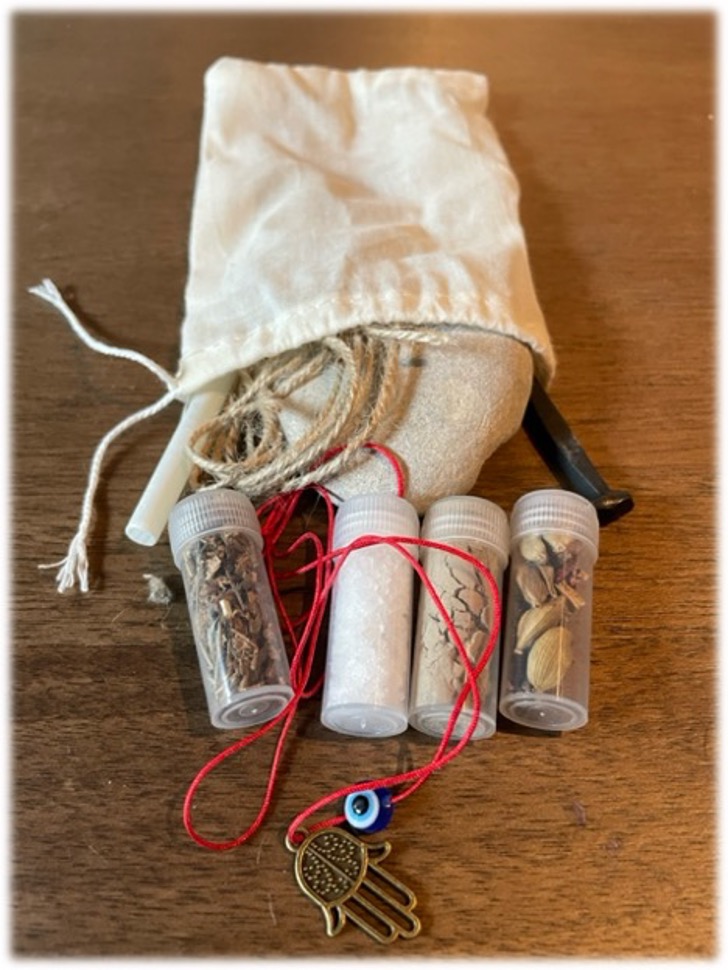
My Jewish monster hunting kits! Perfect for dealing with Shedim and Estries!
This kit has what it takes to protect you from shedim (demons), estries (female vampires), ghosts, and the evil eye (jealous looks that can harm), so you can be safe on the go:
Hardwood ash. It will help you see where shedim (demons) walk. Sprinkle it around your bed at night. Just to be sure.
Besamim (Havdalah spices). Shedim hate its holy scent.
An iron nail. Repels shedim when you’re away from home.
Salt. Sprinkle salt in the corners of your room to repel shedim.
Rue. An herb that can protects you from the evil eye.
Hamsa. A symbol of a hand that blocks the evil eye.
Twine. Tying up an estrie’s hair takes away her power.
A stone. Killing an estrie isn’t hard, but they won’t stay dead unless you bury them with a rock in their mouth. You can also place the stone on a gravestone to keep the ghost in the grave anchored to its resting spot.
This kit is a small sampling of what a Jew, whether Sephardic, Ashkenazi, or Mizrachi, might carry or have on hand. Also included with the kit is a short zine which provides additional background on the elements of the kit, Jewish magic and monster lore, and points to additional resources to start learning about this fascinating part of Jewish life.
The kit comes with a glossy postcard describing each of the items in the kit. Also at my Ko-Fi store.
Fourth, Articles and Teaching!
Over the last couple of years, I’ve had the opportunity to write two articles for the Jewish Review of Books website. The first, “As The Story Goes: Hanukkah Spears, Cheese, and Goblins” talks about Hanukkah stories from Jewish lore and the second “Total Eclipse of the Bracha” is about how whether or not we say a bracha over an eclipse is based on whether or not we, as many Jews historically do, believe a bracha is a bad omen.
This week I have a third article coming out that I’m really excited about. Rabbi Danya Ruttenberg invited me to write a guest post titled “Let’s Talk about Angels, Shedim, and Giants” for her wonderful Life is a Sacred Text substack/blog. In this article, I talk about my experiences studying Jewish monsters and magic and why I think it’s important to reintroduce them back into Jewish discourse and spiritual practice. We’ve lost a lot by sweeping them into the corners. Check it out and see if you agree!
I’ve also done some teaching and storytelling at Temple Beth Emeth and Congregation Beth Israel in Ann Arbor, Michigan, and at Temple Beth Tikvah in Fullerton, California. If you’ve got a synagogue or group that would like me to come and visit, let me know!
Jack telling Jewish scary stories at Temple Beth Tikvah in Fullerton, California*
Finally, Social Media. I’m really active on social media under the name @AdneSadeh on X/Twitter, Bluesky, and as Jewish Monster Hunting on Instagram.
This is a long way of saying that while the blog has been quiet, I’ve been super busy with Jewish monster hunting activities. I miss the blog format, though and hope to get back to it someday.
*The cool t-shirt I’m wearing in the picture is of a seraph, a flaming fiery serpent that God sent to plague the Hebrews during the Exodus. The shirt was made by John and my buddy Marti Fuerst, who’s done a bunch of great Jewish magic and monster shirts and also did the Wayward Children podcast logo. She’s also the Wayward Children podcast archivist! She maintains a GoodReads list of all the books we’ve referenced. Check out her Jewish art and buy her shirts at MartiFuerst.com. I’ve five of them and wear them non-stop!
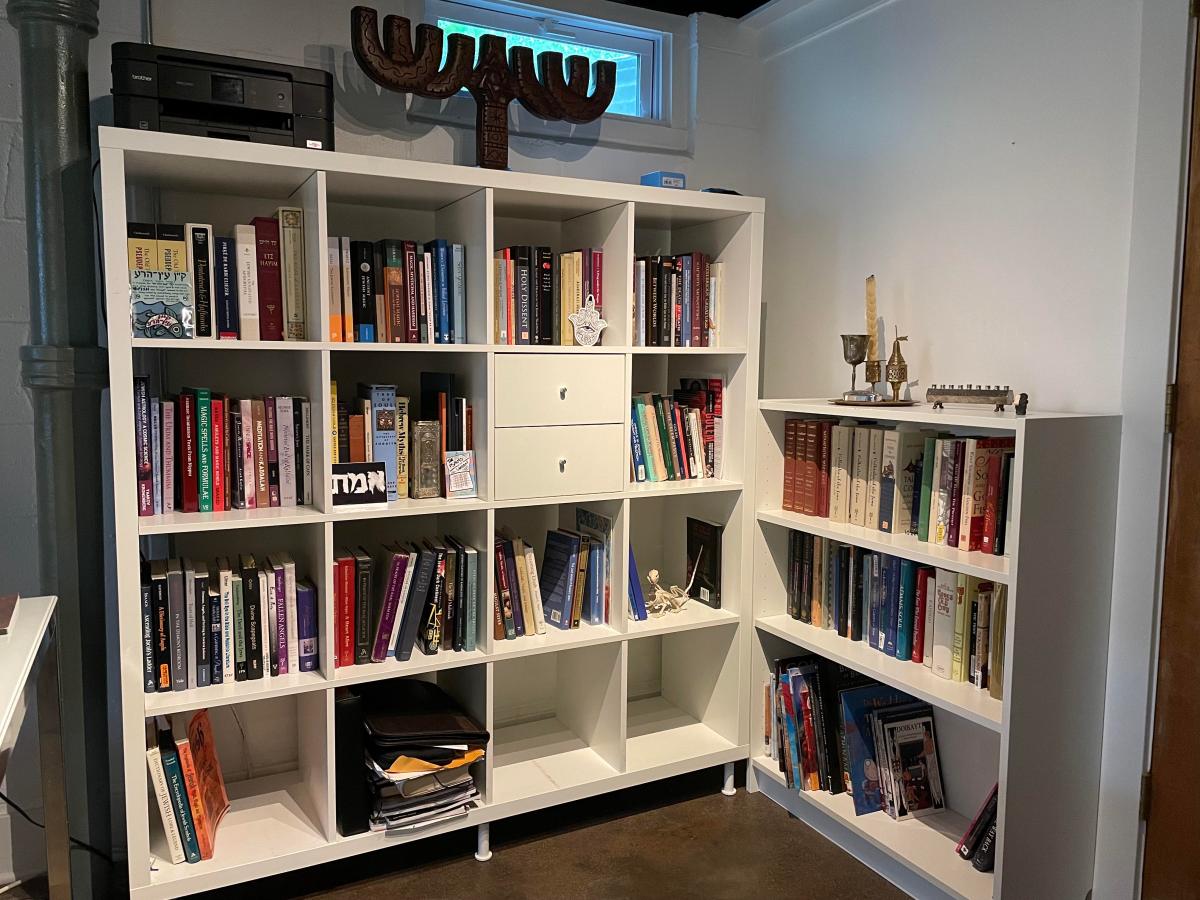
I’ve been building a library of books in English on Jewish monsters and magic. Here are the books I come back to over and over again.
Jews are the People of the Book, right? So it figures that if you want to learn about about Jewish monsters and magic then you might want to grab a few. Over the last couple of years I’ve shared a few versions of a starter list. Over time it’s grown into this list here.
Two things about this list. First, the focus here is on books and articles written or translated into English. There’s lots more great stuff out there in Hebrew, Yiddish, Ladino, and Judeo-Arabic but I’m not able to cover that. I can’t do much past basic prayerbook Hebrew. Someday I’m going to fix that.
Second, the folks who’ve asked me for reading lists have done so for their own, and often very different, reasons and have needed very different lists. These have included:
Jewish fiction writers, artists, and game designers wanting a better basis than what our synagogues or pop culture have delivered
Jewitch practitioners, looking at Biblical divination methods, Sephardi protection charms, or Ashkenazi folk healing methods to add richness to their daily lives
LGBT Jews and others with a complicated relationship with Judaism who approach Judaism with a deep love and a DIY attitude
women who realized that their grandmothers, or great-great-grandmothers, had a ritual life that never got handed down to them
others, like me, that are just nerds for this stuff and find our lives and Judaism enriched by it
Regardless of why you’ve found this list, I hope that you find resources that are useful. If you want a bigger list, I’ve got a LibraryThing list of all the books in my library. All sorts of wild stuff. For the articles, I’m only listing stuff that is easily available free online. Some of my favorite articles aren’t on the list beause they require JSTOR access. If you can’t find what you’re looking for, or want some help finding the right resource leave a comment on the page, or message me on twitter @adnesadeh and let me know what you’re looking for.
Some of the articles I list are posted on Academia.edu. Free registration is required. In most cases the books are easily available wherever you buy books. Most of my links will be to Bookshop.org, which helps you buy new books from local stores, or Alibris, which is a good used-bookstore aggregator site. In some cases, though, your best bet is to go right to the publisher. Some of these are kinda pricey academic books. But most aren’t.
I’m sure I’m going to update this occasionally. So check back. This version is dated April, 18, 2023, one night before the funeral of my father Dr. Joseph Zaientzז״ל.
Update 1. Dec 26 2022. Added two books on legendary figures (the Baal Shem Tov and Rabbi Ya’aqov Wazana), Rabbi Aryeh Kaplan’s book on Jewish Meditation, and a video of the Moroccan Tahdid sword ceremony for a brit milah.
Update 2. Dec 30 2022. Added essays on Jewish astrology, Jewish “superstitions” in the 1920’s, ruach ra’ah, the “last” Jewish demon (still actively included in Jewish ritual). and an amazing essay on the anti-demon aspects of Jewish weddings which includes a summary of the three main Jewish anti-demon strategies; fight, bribe, and conciliate them.
Update 3. Small update adding Dr. Sara Ronis’ article on Ashmedai, demon king and sometime Torah scholar, and Rabbi Elli Fischer’s video presentation on how smoking pipes was used to replicate temple incense and used to fight plagues.
Update 4. Nov 21, 2025. Added Ginzberg’s Legends of the Jews, Samuel Glauber-Zimra’s on Jewish spiritualism (e.g., seances), and the collection “In praise of Baal Shem Tov [Shivhei ha-Besht].”
Jewish Magic and Monsters 101
Super Fast, Super Fun Intros
Check out Ezra Rose’s one page print & fold zines. They’re free or pay what you want.
The Ceremony of Breaking a Glass at Weddings. 1925 essay by Rabbi Jacob Z. Lauterbach. Describes three strategies for countering demons (fight, bribe, and conciliate them) and how many modern Jewish rituals have anti-demon origins or aspects including, you guessed it, breaking a glass at weddings.
The last Talmudic demon? The role of ritual in cultural transmission. by Richard Sosis. “I briefly survey the historical trajectory of demonic beliefs across Jewish communities and focus on one demon, a ruach ra’ah, that has survived the vicissitudes of Jewish history and maintained its relevance in contemporary Jewish communities.”
A Demon for the Ages – Sara Ronis. A short history of Ashmedai, demon king and Torah scholar
Sources in Translation
Seferia.org – “Sefaria is home to 3,000 years of Jewish texts. We are a non-profit organization offering free access to texts, translations, and commentaries so that everyone can participate in the ongoing process of studying, interpreting, and creating Torah” While not everything at Seferia is translated into English, a lot is. I pretty much live there. Tanakh, Talmud, later writings, dictionaries. Everything crosslinked to commentary. So many wonderful texts. Also check out their Source Sheets, which Seferia users put together on interesting topics. To get you started, here are 5 sources.
Deuteronomy 3.11 – “Only [the giant] King Og of Bashan was left of the remaining Rephaim. His bedstead, an iron bedstead, is now in Rabbah of the Ammonites; it is nine cubits long and four cubits wide, by the standard cubit!”
Sanhedrin 65b – “Indeed, Rava created a man, a golem, using forces of sanctity. Rava sent his creation before Rabbi Zeira. Rabbi Zeira would speak to him but he would not reply. Rabbi Zeira said to him: You were created by one of the members of the group, one of the Sages. Return to your dust.”
Chagiga16a – “The Gemara returns to discussing the heavenly beings. The Sages taught: Six statements were said with regard to demons: In three ways they are like ministering angels, and in three ways they are like humans.”
Berakhot 6a – “In another baraita it was taught that Abba Binyamin says: If the eye was given permission to see, no creature would be able to withstand the abundance and ubiquity of the demons and continue to live unaffected by them.”
Otzar Midrashim 2c (alternate version of the Alphatbet of Ben Sira) – “He said to him, “The angels appointed for healing: Sanoy, Sansanoy, Semangalof. When the Holy Blessed One created the first Adam alone, They said, (Genesis 2:18) ‘It is not good for this Adam to be alone.’ They created for him a wife out of the Earth like he had been, and called her Lilith. Immediately they began to challenge each other.”
Books
Jewish Magic and Superstition by Rabbi Joshua Tractenberg. Written in 1939, Jewish Magic and Superstition is still the best starting point. It focuses on 13th century Ashkenazi Jewish lore which is as wild as it comes. It’s inexpensive and easily available. JMS is also online at Sacred-Texts.com. Highly recommended.
The Encyclopedia of Jewish Myth, Magic and Mysticism by Rabbi Geoffry Dennis. Exactly what the title describes. Encyclopedic in scope, but very short descriptions. A great gift and great for finding things of interest, but you’ll want more if you want to understand something with any depth
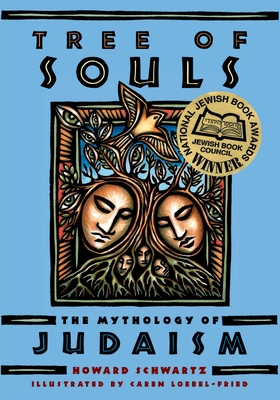
Tree of Souls: The Mythology of Judaism by Harold Schwartz. So good. Mostly covers legends up to the Talmudic period and some Zohar. Wonderful writing and great commentary.
Legends of the Jews by Louis Ginzberg. 1909. All the best Biblical midrash rewritten into an easy to read continuous narrative from Genesis through Esther. (Link is to Seferia.org, but the Jewish Publication Society has a lovely 2-volume set that I personally think should be on every Jewish tween’s bookshelf though it’s a too bit pricey for that. There are lots of cheaper reprints available too.)
Magic, Mysticism, and Hasidism: The Supernatural in Jewish Thought by Gedalyah Nigal. Nigal describes the Baal Shem “wonder rabbis” and their amulets, holy name magic, kefitzat ha-derekh (“shortening of the path” or Jewish teleportation), transmigration of souls (reincarnation), and demonic possession. This one’s harder to get. As of today Alibris has a reasonably priced copy.
Ritual Medical Lore of Sephardic Women: Sweetening the Spirits, Healing the Sick by Isaac Jack Lévy and Rosemary Lévy Zumwalt. An amazing exploration of prekante, or charms, in the Sephardic community. If you want to be ready to handle the evil eye, this is the book. Also, this is a must read if you want to learn more about Jewish women’s rituals.
Ashkenazi Herbalism. “Deatra Cohen and Adam Siegel add a new dimension to our picture of everyday life in the Pale of Settlement with a highly readable portrayal of folk healers, herbs, and medicinal practices.” Great book for a modern practitioner to draw on but its presentation of Askhenazi medical lore is way too sanitized for me. Where are the cures based on wearing a mouse around your neck or eating fried sawdust? Where’s the horse teeth and lead?
A Remembrance of His Wonders: Nature and the Supernatural in Medieval Ashkenazby David Shyovitz. “Analyzing a wide array of neglected Ashkenazic writings on the natural world in general, and the human body in particular, Shyovitz shows how Jews in Ashkenaz integrated regnant scientific, magical, and mystical currents into a sophisticated exploration of the boundaries between nature and the supernatural.” The werewolf article, above, became a chapter in this book.
On My Right Michael, On My Left Gabriel: Angels in Ancient Jewish Culture by Mika Ahuvia. “Angelic beings can be found throughout the Hebrew Bible, and by late antiquity the archangels Michael and Gabriel were as familiar as the patriarchs and matriarchs, guardian angels were as present as one’s shadow, and praise of the seraphim was as sacred as the Shema prayer” Fantastic discussion of angels in Judaism.
Demons in the Details: Demonic Discourse and Rabbinic Culture in Late Antique Babylonia by Sara Ronis. “The Babylonian Talmud is full of stories of demonic encounters, and it also includes many laws that attempt to regulate such encounters. In this book, Sara Ronis takes the reader on a journey across the rabbinic canon, exploring how late antique rabbis imagined, feared, and controlled demons.”Another book that as academic in depth but very readable.
Amulets and Magic Bowls: Aramaic Incantations of Late Antiquity by Joseph Naveh and Shaul Shaked. “Amulets and magic bowls are part of a long-standing tradition of magic in the Near East. They were used to protect the home and inhabitants of the home from evil and disease as well as to arouse love. Texts taken from these items provide insight into the society, religion, and culture of pagans and Jews during the early Christian era which corresponds to that of the Talmudic period.”
Jewish Meditation: A Practical Guide by Rabbi Aryeh Kaplan. “Students of mediation are usually surprised to discover that a Jewish mediation tradition exists and that it was an authentic and integral part of mainstream Judaism until the eighteenth century. Jewish Meditation is a step-by-step introduction to meditation and the Jewish practice of meditation in particular.” He’s an amazing writer who was deeply involved in the meditative aspects of Kaballah. And yeah, this is the same person who wrote a commentary on the Serfer Yetzirah (see below)
Sefer Yetzirah: The Book of Creation. Rabbi Aryeh Kaplan translation. The Sefer Yezirah describes the mystical process by which God created the universe and is traditionally, the text that rabbi’s studied to learn how to make golems. Kaplan’s translation is tiny part of the book, it’s his commentary on the Sefer Yetzirah that makes this a must read.
Sword of Moses. Yuval Harari translation. As Harari notes, of the “two Jewish magical treatises – the other being the Sefer ha-Razim (The Book of Mysteries) – that have survived from antiquity in many respects [the Sword of Moses] is the more significant one. It presents a broad assortment of magical practices for accomplishing various goals, all based on the use of a magical ‘‘sword’’ of words, which Moses brought down from heaven.” The link is to a downloadable .pdf from Academia.edu
Sefer ha-Razim, The Book of Mysteries. Michael Morgan translation. The Sefer-ha Razim is a “Jewish magical text supposedly given to Noah by the angel Raziel, and passed down throughout Biblical history until it ended up in the possession of Solomon, for whom it was a great source of his wisdom and purported magical powers.” (quote from Wikipedia)
Shimmush Tehillim (Magical uses of the Psalms). Attributed to Rav Hai Goan, document by Reuven Brauner. Describes magical uses of the Psalms for protection from demons, protection from miscarriage, and a lot more. The link is a downloadable .pdf from Halakhah.com
The Aleph-Bet Bookby Rebbe Nachman of Bresolv. Not a spellbook, per se, but tucked in with the Rebbe’s aphorisms on how to live a good Jewish live are a wonderful assortment of segulah (charms).
Beliefs about Death
Jewish Views of the Afterlife by Simcha Paull Raphael. “Jewish Views of the Afterlife is a classic study of ideas of afterlife and postmortem survival in Jewish tradition and mysticism. As both a scholar and pastoral counselor, Raphael guides the reader through 4,000 years of Jewish thought on the afterlife by investigating pertinent sacred texts produced in each era.” Another must read.
Final Judgement and the Dead in Medieval Jewish Thought by Susan Weissman. “Through a detailed analysis of ghost tales in the Ashkenazi pietistic work Sefer Hasidim, Susan Weissman documents a major transformation in Jewish attitudes and practices regarding the dead and the afterlife that took place between the rabbinic period and medieval times.” Ghosts. The walking dead. Here it is folks.
Folklore Collections
Lilith’s Cave: Jewish Tales of the Supernatural selected by Harold Schwartz. Great collection from around the Jewish world. Includes stories about Lilith and “The Finger,” one of the inspirations for the Tim Burton film “The Corpse Bride.”
Yiddish Folktales translated by Beatrice Weinreich. Includes stories about early modern Jewish monsters including shretelech, who are sprites that, if shown respect and given gifts, will protect the house.
In praise of Baal Shem Tov [Shivhei ha-Besht] : the earliest collection of legends about the founder of Hasidism translated and edited by Dan Ben-Amos and Jerome R. Minz. Includes the Baal Shem Tov fighting a werewolf and other amazing stories originally recorded by the Besht’s students and their followers. The book is in print. The link goes to the online Internet Archive copy.
Without Bounds: The Life and Death of Rabbi Ya’aqov Wazana. “Without Bounds illuminates the life of the mysterious Rabbi Ya’aqov Wazana, a Jewish healer who worked in the Western High Atlas region in southern Morocco and died there in the early 1950s. Impressed by his healing powers and shamanic virtuosity, Moroccan Jews are intrigued by his lifestyle and contacts with the Muslim and the demonic worlds that dangerously blurred his Jewish identity.”
Late Modern period (mid-18th century to the 1920’s)
The Jewish Dark Continent: Life and Death in the Russian Pale of Settlement by Nathaniel Deutsch. “Just before World War I, a socialist revolutionary and aspiring ethnographer named An-sky pledged to explore the Pale. He dreamed of leading an ethnographic expedition that would produce an archive—what he called an Oral Torah of the common people rather than the rabbinic elite—which would preserve Jewish traditions and transform them into the seeds of a modern Jewish culture. … Consisting of 2,087 questions in Yiddish—exploring the gamut of Jewish folk beliefs and traditions, from everyday activities to spiritual exercises to marital intimacies—the Jewish Ethnographic Program constitutes an invaluable portrait of Eastern European Jewish life on the brink of destruction.” No one every answered any of An-sky’s questions, but the questions themselves are a portrait of Ashkenazi Jewish beliefs.
Og, King of Bashan riding a Unicorn from Aunt Naomi’s Jewish Fairy Tales and Legends
Other Media
There’s a lot of great material out there and a lot of weird stuff that I stay away from. Here are a few bits I know about and want to share.This list is also really short on rabbinic material. I need to fix that. I’ll cover Jewish monsters and magic artists in another posts.
Podcasts
Jewitches – “Talking about all things Jewish witchcraft, mysticism, folklore, magic, and practice. Bi-weekly deep dives into all things magical & Jewish, hosted by Jewitches.com”
Throwing Sheyd – “Better living through Jewish demonology”. 48 episodes deep dive into Jewish demons filled with warm and wisdom. Alan a nd Miriam are great hosts.
Websites
Pulling Threads – Rediscovering the forgotten rituals of Eastern European Jewish Women
Videos
Jewish Monster Hunting – A practical guide to Jewish Monster Hunting. This is my channel. Only one video so far, but it’s a fun one.
10 Historic Jewish Women Mystics You’ve (Probably) Never Heard of “Are there any Female Jewish Mystics or is Jewish Mysticism just a Boys Club? Join us as we explore ten incredible women Mystics, Martyrs, Mothers, Messiahs, masters of Kabbalah, Educators, Oracles, Patrons, Prophets, Poets and Philosophers who left an unforgettable mark on Jewish History.”
Plagues – Rabbi Elli Fischer. When smoking a pipe became a ritual substitution for burning incense to ward off plague.
“The word Tahdid comes from hdid, metal, in Arabic, bringing in technologies of metallurgy to protection rituals. The women used to hold the mother and baby ‘hostage’ in the room and barter jokingly with the men who were knocking at the door and begging to come in. Joking negotiations back and forth in Judeo-Arabic were meant to make everyone laugh and ensure that everyone knew where the real power was! Once allowed into the mother’s room, the men sang liturgical poetry in Judeo-Arabic and Hebrew, lightly tapped ritual swords against the walls of the four corners of the room, on the baby’s crib and on the four cardinal points, all the places where the evil spirits are said to hide. They then continued singing mystical poems and murmuring prayers in Hebrew and the women finished with loud yuyus of celebration. Afterwards there is a feast for everyone gathered. This Tahdid, from July 2013, was led by the paytan Jacob Wizman, a student of the famous Rabbi David Bouzaglo. Filmed in Casablanca by Ron Duncan Hart.”
According to the Jewish tradition, there are three righteous people who never died. Or maybe it’s seven (1). Or nine (2). It depends on the source. But all the sources I know of agree on the first three. They are Enoch, who walked with God (3); the prophet Elijah, who ascended to heaven in a whirlwind (4); and Serah, blessed by God with wisdom and by her grandfather Jacob with eternal life. Jewish monster hunters should be on the lookout for Serah. Throughout her life she has been a wise protector and keeper of our forgotten knowledge. (And as I’ll write about next week, a werewolf hunter!) Wouldn’t it be something, to sit with her for an hour and learn from her stories? Or to offer her our company and aid?
Serah’s stories are high adventure! Grab some popcorn and let’s go!
Ephraim Moses Lillian’s “The Song of Life” (5) While, as far as I know, not intended to be a representation of Serah, I think this image captures her perfectly.
Serah bat Asher & The Gift of Wisdom
Serah was the adopted daughter of Asher and the granddaughter of Jacob, the Patriarch. She was first mentioned in the Torah in the list of Jacob’s household that moved to Egypt, under the protection of Joseph (6). This mention, to careful readers such as Rabbi’s and Jewish monster hunters, is striking. While there is a long list of Jacob’s grandsons, she is the only granddaughter named. So why was she so important? Because, along with Joseph, she was one of two spiritual heirs of Jacob. Serah’s uncles (and two cousins) might have been founders of the 12 tribes, but they were mostly jerks. Eight of them sold her (ninth) uncle Joseph into slavery, right? And, as I mentioned in my previous blog post, her 10th uncle, Benjamin, was a werewolf! Nice family, right? Well, according to the Sefer Yasher, Serah was special from the start.
And after the death of Asher’s wife he went and took Hadurah for a wife, and brought her to the land of Canaan. And Serah her daughter he brought also with them, and she was three years old; and the damsel was brought up in Jacob’s house. And the damsel was of comely appearance, and she went in the holy ways of the children of Jacob, and the Lord gave her wisdom and understanding.
Sefer HaYasher, Bereshit, Vayeshev. (7)
Serah, according to the Sefer HaYasher, is a prophet blessed by God with wisdom, similar to her uncle Joseph. It was Serah who told Jacob that Joseph was still alive. This was a big deal. Joseph was Jacob’s favorite son. When, years earlier, Serah’s jerk uncles claimed (falsely) that Joseph had been killed by a wild animal, it almost killed Jacob (8). Now, Serah’s uncles have gone to Egypt, humbled by drought and begging for food, and come back with incredible news. Joseph is alive, has forgiven them, is a high ranking officer under Pharaoh, and wants them to move to Egypt under his protection. But Jacob’s an old man now. How could they tell Jacob without shocking and possibly killing him? They asked Serah to do it.
Serah knew her grandfather well. She had studied with him and was devoted to him (9). She chose just the right moment. Jacob stood in prayer, strengthened by his devotion to God, and Serah joined him joyfully, playing her harp and singing (10). As the Midrash HaGadol tells it….
[The brothers said:]If we tell him right away, “Joseph is alive!” perhaps he will have a stroke [lit., his soul will fly away]. What did they do? They said to Serah, daughter of Asher, “Tell our father Jacob that Joseph is alive, and he is in Egypt.” What did she do? She waited till he was standing in prayer, and then said in a tone of wonder, “Joseph is in Egypt/ There have been born on his knees/ Menasseh and Ephraim” [three rhyming lines]. His heart failed, while he was standing in prayer. When he finished his prayer, he saw the wagons: immediately the spirit of Jacob came back to life.
Midrash HaGadol on Genesis 45:26. Translated by Avivah Zornberg (11)
Imagine the power of the moment. Jacob is caught up in his prayers and hears a beloved voice telling him what he always wanted to hear but would never have believed. His broken spirit flies away and returns whole. Joseph is alive. Jacob will live and in gratitude he blesses Serah. And, as I’ve discussed before, the blessing of a patriarch is an immensely powerful thing. Jacob says….
My daughter, may death never prevail against thee forever, for thou hast revived my spirit, only repeat thou this song once more before me, for thou hast caused me gladness with thy words.
Sefer HaYashar, Book of Genesis, Vayigash (10)
Serah has been blessed to live forever.
Ok. A quick digression. This first part of Serah’s story connects with how we Jews got to Egypt. In the second part, Serah’s story connects with how we leave. Then the third part connects with how we remember the Exodus.These connections, and the parallels between Serah’s immortality and that of the prophet Elijah’s, makes Serah’s story great to tell at a seder table.If that sounds like fun, you might check out “Serach at the Seder” by Yitzhak Buxbaum (12). He did a lovely job writing a haggadah supplement. Or make your own that fits your seder.
Yitzhak Buxbaum’s “Serach at the Seder: A Haggadah Supplement.” (12)
Serah bat Asher, Keeper of Secrets
Jacob’s descendants are crying out in slavery. 400 years has passed from the time that Serah accompanied her tribe to Egypt and a new pharaoh has forgotten Joseph. But Serah still lives. She still remembers the her youth, the high country side, the smells of cooking and animals, the singing at night, and the prayers, as well as Jacob and all she learned from him. Then Moses comes and demands, in the name of God, that Pharaoh release the Hebrews and, just as boldly, demands that the Hebrews be ready to follow him out of Egypt. The Hebrews were confused and scared. Had God finally remembered them? Would Moses demands be met? Or would Moses’s demands bring down additional suffering? The terrible days of Pharaoh’s army murdering newborn Hebrew boys was not that many years ago and still hung over them. Follow Moses? Or reject him? How would they decided? Again, the tribe turned Serah. The Pirkei D’Rabbi Eliezer tells the story….
When Moses and Aaron came to the elders of Israel and performed the signs in their sight, the elders of Israel went to Serah, the daughter of Asher, and they said to her: A certain man has come, and he has performed signs in our sight. She said to them: There is no reality in the signs. They said to her: He said “God will surely visit you.” She said to them: He is the man who will redeem Israel in the future from Egypt, for thus did I hear, “I have surely visited you” (Exodus 3:16). Forthwith the people believed in their God and in His messenger, as it is said, “And the people believed, and when they heard that the Lord had visited the children of Israel” (Exodus 4:31)
A slightly simplified version of Pirkei D’Rabbi Eliezer 48:17 (13)
Serah had learned deep lessons of Torah from Jacob, who learned them from Isaac who learned them from Abraham and from the school Shem and Ever (9). She recognized Moses’ language for what it was, the prophesied words of God. In so doing, she connected the current generation of Hebrews to the teachings of her teachers and to their own history…and gave them courage and faith.
Finally Pharaoh gave the word that the Hebrews were free and the Hebrews scrambled to ready themselves. But there was still a major task to be done before they could follow Moses out of Egypt. The bones of Joseph had to be found. Joseph, Serah’s uncle who had brought Serah and the tribe to Egypt, had made them swear that they would not leave him behind when they would finally leave Egypt (14). And even with the chariots of Pharaoh readying themselves to give chase, the promise had to be kept.
Moses, who grew up in the home and temples of Pharaoh, did not know where Joseph had been buried. The elders of the Hebrews did not know either. The priests of Egypt, who knew of the promise, had buried Joseph in secret to keep Joseph’s holy body for themselves and to keep the Hebrews from ever leaving. But Serah knew. She’d stood and watched as her uncle’s metal casket was dropped into the same stretch of the Nile river that would later carry Moses’ wicker basket, and even later run with blood.
The Gemara asks: And from where did Moses our teacher know where Joseph was buried? The Sages said: Serah, the daughter of Asher, remained from that generation that initially descended to Egypt with Jacob. Moses went to her and said to her: Do you know anything about where Joseph is buried? She said to him: The Egyptians fashioned a metal casket for him and set it in the Nile River as an augury so that its water would be blessed. Moses went and stood on the bank of the Nile. He said to Joseph: Joseph, Joseph, the time has arrived about which the Holy One, Blessed be He, took an oath saying that I (God) will redeem you. And the time for fulfillment of the oath that you administered to the Jewish people that they will bury you in Eretz Yisrael has arrived. If you show yourself, it is good, but if not, we are clear from your oath. Immediately, the casket of Joseph floated to the top of the water.
Sotah 13a (15)
Ok. There’s a lot going on here. Metal caskets (think big amulet), Egyptian magic spells, omens of thefuture, talking to the dead. Moses is channeling a lot of God’s power. A big part of the Jewish magic tradition centers on Moses. Too much to get into here, but I’ll write lots about it later.
Moses and Serah collected Joseph’s casket and, with the Hebrews, carried it out of Egypt and through the Red Sea. Later, describing the long journey to the promised land, the book of Numbers provides a careful accounting of the Hebrews that survived a plague. Again, the count and the names are those of men (elders and warriors). And again, Serah daughter Asher, granddaughter of Jacob, is counted and named. Even then, she stood watch over us, sharing her wisdom and teaching, joining Miriam in song.
(44) Descendants of Asher by their clans: Of Imnah, the clan of the Imnites; of Ishvi, the clan of the Ishvites; of Beriah, the clan of the Beriites. (45) Of the descendants of Beriah: Of Heber, the clan of the Heberites; of Malchiel, the clan of the Malchielites.— (46) The name of Asher’s daughter was Serah.— (47) These are the clans of Asher’s descendants; persons enrolled: 53,400.
Numbers 26:44-47 (16)
MONSTER HUNTER PRO TIPS
1. Make for yourself a mentor, acquire for yourself a friend(17). Serah studied with Jacob. We won’t be so fortunate, but maybe we can study and befriend Serah. And, if not, there are lots of teachers and sources.
2. Be on the lookout for the immortals and other long lived folks. There are many in the tradition.Honor them and support them, as we do all our elders.
2. Blessings are powerful things. While we don’t live in the days of the patriarch’s, there have been other tzadik’s (holy people) who could change the world with a blessing. Maybe there still are.
4.Be wary of other magic.Moses used God’s power to talk to Joseph and raise his bones…but it wasn’t Jewish magic that sank Joseph in the first place.
Serah bat Asher, Teacher of the Sages
Two thousand years later, Serah was still standing watch over us, still sharing her wisdom and still singing. Somewhere around 200 CE, Serah was living in the north of Roman ruled Israel, near Galilee. It was a time of persecution (as most times seem to be). The second Temple had long since fallen and the teachings of the Pharisees had not yet been written down as the Mishna. These teachings were still taught orally, from teacher to student. Serah didn’t study with the teachers, she’d been taught by well Jacob two and half millenia ago. But she did listen in, from time to time, to understand what was being taught. And, occasionally, to make corrections.
Rabbi Yohanan was once sitting and expounding about how the waters became like a wall for Israel [at the time they miraculously passed through the Sea which had split open before them to permit their Exodus from Egypt (see Exodus 14:29, “and the waters were a wall for them on their right and on their left”). Rabbi Yohanan explained that the waters looked “like a lattice.” However, just at that moment, Serah bat Asher looked in and said: “I was there and they (the waters) were not like that but rather like lighted windows”
From Pesikta de-Rav Kahana (10:117), Marc Bergman translation (18)
The Providence Lithograph Company [Public domain] (19)
Next week, I’ll continue the story of Serah, with The Exile of Serah and Serah bat Asher, Werewolf Hunter!
Ok. One last digression. I’m a long time music head. I used to write the blog Teruah: Jewish Music. Alicia Jo Rabins is one of my favorite Jewish songwritersand teachers. She’s recorded 3 album’s under the title Girls in Troublethat are both wonderful musicand masterful feminist midrash. As Rabin’s describes it, Girls in Trouble is a “indie-folk song cycle about the complicated lives of women in Torah.”Here’s her take on Serah, called “Tell Me.”
Tell Me(20)
The waters parted but it wasn’t like they said, no iron wall came down to hold them. Has there been a loneliness like mine, touching all the hidden walls of time?
Notes and References (1) According to Tractate Kallah Rabbati 3:25 “Seven people entered Gan Eden alive, namely: Serach, as it says, I am one of those who seek the welfare of the faithful in Israel. I am the one who completed the number of those who entered Gan Eden” (Hebrew). I’m borrowing this translation from Mark Solomon’s Sefaria sheet “Serach bat Asher – The Transmitter of Secrets” I’ve reached out to Solomon to see if it’s his translation and will update this when I know. https://www.sefaria.org/sheets/132068?lang=bi (2) According to Tractate Derekh Eretz Zuta 1:18, “Nine people entered Gan Eden alive, namely: Enoch son of Jared, Elijah, the Messiah, Eliezer the servant of Abraham, Hiram king of Tyre and Eved-Melech the Ethiopian, Jabez the [grand]son of Judah (see I Chronicles 4:9-10), Batya the daughter of Pharaoh, and Serach bat Asher, and some say also Rabbi Joshua ben Levi.” I’ll write about all nine, eventually. I’m borrowing this translation from Mark Solomon’s Sefaria sheet “Serach bat Asher – The Transmitter of Secrets”https://www.sefaria.org/sheets/132068?lang=bi (3) Enoch is described as walking with, being taken by taken, by God in Genesis 5:23 and 5:24. https://www.sefaria.org/Genesis.5?lang=en&aliyot=0 (4) Elijah ascends via whirlwind in II Kings, Chapter 2, verse 1. https://www.sefaria.org/II_Kings.2?lang=en. No…he did not land on the Witch of the West. You’re thinking of Dorothy. (5) “Song of Life” from New Art of an Ancient People: The Work of Ephraim Moses Lillian by M. S. Levussove. I’m crazy about Lillian’s work. I color adjusted it a bit from a scanned original printing available at https://archive.org/details/newartanancient00levugoog/page/n18. (6) Serah’s first mention in Genesis 46.17 https://www.sefaria.org/Genesis.46.16?lang=en&with=all&lang2=en (7) Sefer ha-Yasher is a Hebrew Midrash on early biblical history. This english is from the Edward B.M. Browne, New York, 1876 English translation. https://www.sefaria.org/Sefer_HaYashar_(midrash)%2C_Book_of_Genesis%2C_Vayeshev?ven=Sefer_ha-Yashar,__trans._Edward_B.M._Browne,_New_York,_1876&lang=bi (8) Genesis 37:35 says of Jacob that All his sons and daughters sought to comfort him; but he refused to be comforted, saying, “No, I will go down mourning to my son in Sheol.”Thus his father bewailed him.https://www.sefaria.org/Genesis.37?lang=en&aliyot=0 (9) According the Jewish tradition, there was already a great deal to study by the time of Jacob and Serah, including the Sefer HaMalaach Raziel (Book of the Angel of God’s Secret) written by Adam and the Sefer Yetzirah (Book of Creation) written by Abraham, as well as pre-flood Torah and mystical teachings passed down to Jacob’s father Isaac when Isaac studied in the yeshiva (school) of Shem, son of Noah, and Ever, Shem’s grandson. (10) Sefer HaYasher. Book of Genesis, Vayigash. Browne translation. https://www.sefaria.org/Sefer_HaYashar_(midrash)%2C_Book_of_Genesis%2C_Vayigash.9?ven=Sefer_ha-Yashar,__trans._Edward_B.M._Browne,_New_York,_1876&lang=bi (11) Midrash HaGadol, Genesis 45:26, translated by Translated by Avivah Zornberg in her book Genesis, the Beginning of Desire. See her website http://www.avivahzornberg.com/. I found this reference and translation in Moshe Reiss’ excellent essay “Serah bat Asher in Rabbinic Literature.” https://jbqnew.jewishbible.org/assets/Uploads/421/JBQ_421_8_reissserach.pdf (12) Serach at the Seder: A Haggadah Supplement. Yitzhak Buxbaum. You can get a copy from him via website. http://www.jewishspirit.com/Serach/Serach.html. Or you can build your own Serah Bat Asher haggadah supplement that works for you and your seder. (13) The Pirkei D’Rabbi Eliezer tells this story in the context of a fascinating discussion on the role of the letters of the Torah in redemption. Here’s an abbreviated version of it. See Sefaria for the whole text. Rabbi Eliezer said: The five letters of the Torah, which alone of all the letters in the Torah are of double (shape), all appertain to the mystery of the Redemption…..With “Pê” “Pê” Israel was redeemed from Egypt, as it is said, “I have surely visited you, (Paḳôd Paḳadti) and (seen) that which is done to you in Egypt, and I have said, I will bring you up out of the affliction of Egypt” (Ex. iii. 16, 17)….These letters were delivered only to our father Abraham. Our father Abraham delivered them to Isaac, and Isaac (delivered them) to Jacob, and Jacob delivered the mystery of the Redemption to Joseph, as it is said, “But God will surely visit (Paḳôd yiphḳôd) you” (Gen. 1. 24). … Asher, the son of Jacob, delivered the mystery of the Redemption to Serah his daughter. https://www.sefaria.org/Pirkei_DeRabbi_Eliezer.48.17?lang=bi&with=all&lang2=en (14) Exodus 13:19. And Moses took with him the bones of Joseph, who had exacted an oath from the children of Israel, saying, “God will be sure to take notice of you: then you shall carry up my bones from here with you.”https://www.sefaria.org/Exodus.13.19?lang=en&with=all&lang2=en (15) Sotah 13. https://www.sefaria.org/Sotah.13a.14?ven=William_Davidson_Edition_-_English&lang=bi (16) Numbers 26.46. https://www.sefaria.org/Numbers.26.46?lang=en&with=all&lang2=en (17) “Make for yourself a mentor, acquire for yourself a friend” is one of the most famous teachings in Pirkei Avot, the Ethics of our Fathers. https://www.sefaria.org/Pirkei_Avot.1.6?ven=Open_Mishnah&lang=en&with=all&lang2=en (18) Pesikta de-Rav Kahana. Aggadic Midrash written between c.400 – c.700 CE. Translated by Marc Bergman in his outstanding essay “Serah Bat Asher: Biblical Origins, Ancient Aggadah and Contemporary Folklore” https://judaic.arizona.edu/sites/judaic.arizona.edu/files/files-event/Bregman.pdf. Hebrew source available at https://www.sefaria.org/Pesikta_D’Rav_Kahanna?lang=en (19) the Providence Lithograph Company [Public domain] https://commons.wikimedia.org (20) “Tell Me” Alicia Jo Rabins. From the Girls in Trouble album Half You Half Me. https://aliciajo.com/. The Tell Me video was recorded live at the Living Room in Williamsburg, Brooklyn, 2015. Alicia Jo Rabins, vocals, violin and loop pedal; Aaron Hartman, bass.








 Jewish Monster Hunting