My Jewish monster hunting gear boxes were ready to go. But what was in them?
Last night was Shabbat, one of the two nights (along with Tuesday), that Agrat bat Maḥlat, one of the queens of the shedim (aka demons), haunts the air with her train of eighteen myriads of messengers of destruction (1). With Havadalh behind me, I was out on patrol driving around in my beloved Honda Element loaded with all my Jewish monster hunting gear….ready for Agrat or whatever else might happen.
Actually I was home reading. Like usual. But my Jewish monster hunting gear boxes were ready to go. But what was in them?
Before I list out what I’ve collected so far, I want to point out that my gear collection is authentic if a bit eclectic. It draws draws from a range of Jewish sources and time periods, includes Ashkenazi, Sephardic, and Misrachi elements, mixes rabbinic and kabbalistic elements with elements from Jewish women’s segulot and prekante (Hebrew and Ladino terms for household charms) and Jewish medical lore. My goal is was to develop the gear that a modern ba’al shem (wonder rabbi) (2) or babske refuah (wise woman) (3) might have on hand. Just in case Agrat bat Maḥlat shows up or, more practically, I get to teach a class.
Part 1. Here’s a list of my original Jewish monster hunting gear.
In some cases I provide links on where to buy your own. These are just examples. I don’t have any financial relationship with the vendors. Please buy from small local business if you can.
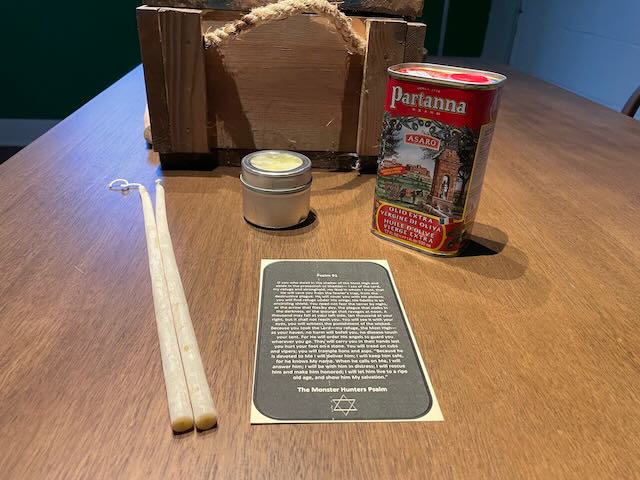
Salt. Shedim and ghosts don’t like salt and it can be used as a barrier.
Iron pins. Traditionally, a Jew would wear an iron pin when traveling. Giving how much metal we carry with us these days wearing an iron pin isn’t really necessary..but it can’t hurt either. (Creating-Unkamen @ Etsy)
Kero masa wood. According to the Talmud (Pesachim 111b), kero masa is harmful to shedim (4). Kero masa is sorbus, also known as the Serviceberry Tree. This stick is Latvian rowan wood, a kind of sorbus. (TrueWilderness @ Etsy)
Shofar. Shedim can be scared by loud noises..so blowing a shofar is a go-to move. This is a cheap one I picked up on my one trip to Israel. Someday I’ll get a better one and learn to blow it properly. (Any local or online Judaica vendor)
A card with text of Psalm 91, the Monster Hunter’s Psalm. Need to memorize this one or keep it handy.
Ketoret Gear
Amber incense. Shedim hate strong smells. Incense points back to the priestly koteret incense (Scents of Earth or a lot of Etsy sellers)
Wooden pipe (for regular tobacco). Shedim hate strong smells but, more importantly, there is a tradition of rabbi’s smoking pipes with the mysitical intention of invoking the powers of the temple incense (koteret) to banish demons and plagues. (Any pipe will do. I like this walnut one. HousewarmingUA)
Amulets
Shmirah amulet (the big one with the upturned hand). Amulet to protect mother and baby from Lilith the demon queen. Amulets like this are hung in baby’s rooms and hospital delivery rooms. (Eichlers)
Anti-COVID amulet. I picked this up on eBay from an Israeli seller. No idea who the scribe was or if it’s intended for the Charedi community or the tourist trade. Probably the latter, but it’s still cool. (eBay)
Hamsa. Anti-evil eye charm. This one’s a cheap key chain. I have a couple of other ones but no really nice ones. (Nice vintage ones show up on eBay regularly. I’ll get one eventually.)
Amulet Making Kit
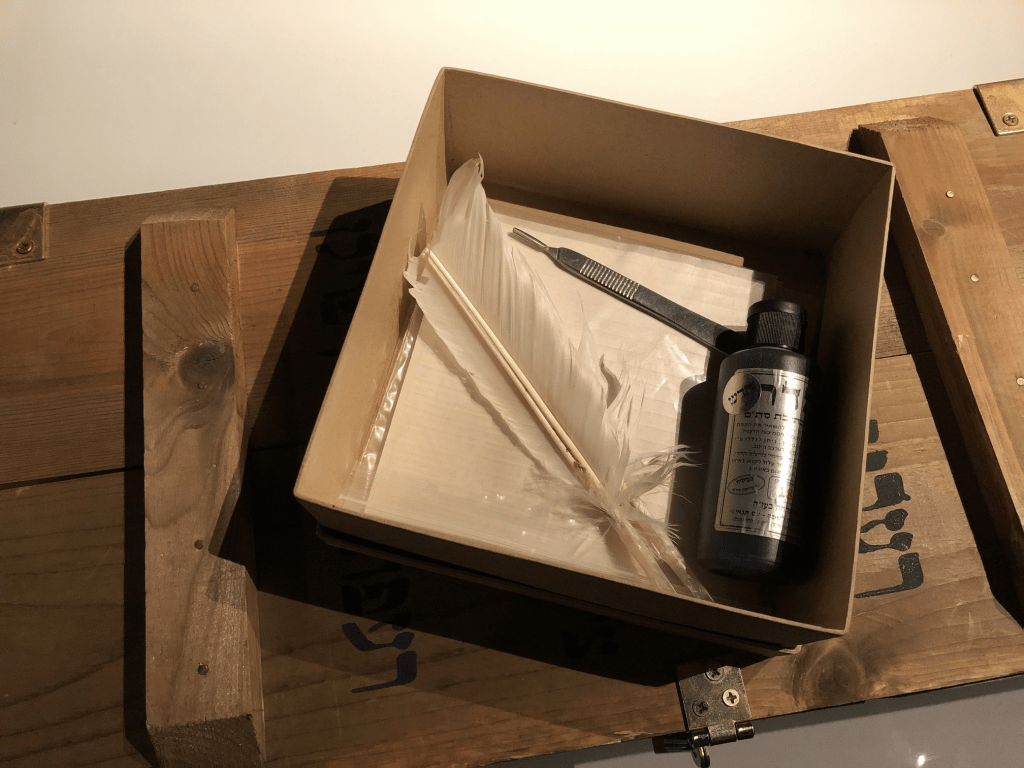
A box of amulet making gear, including kosher torah ink, 5 kosher mezuzah klafs, 2 kosher quills, a metal scribal blade (for scratching out errors) and some replacement blades. – An experienced Ba’al Shem makes their own amulets. (A sofer supply store such as HaSofer)
Estrie Gear
String. For tying up an estries hair. They lose their power when their hair is tied up.
Rocks. Killing an estrie isn’t hard, but getting them to stay dead is. You nead to bury them with rocks in their mouths.
Salt. If you hurt an estrie you can heal it by giving it your bread and salt.
Entrenching Tool
Army surplus shovel / entrenching tool. For digging a trench over a grave, in order to become willingly possessed by with an Ibbur (eBay)
Books
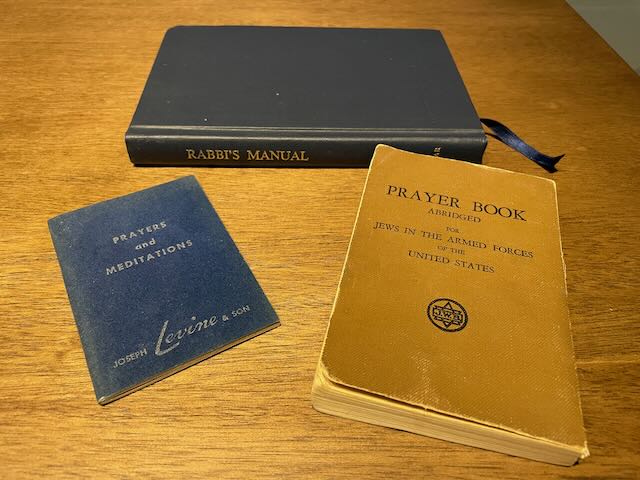
Prayer books. Got to be ready for anything. I carry a vintage US Army Jewish prayerbook, a rabbi’s manual, and small “Prayers and Meditations” for funeral usage. Not in this picture, but I also have a couple of tahara manuals (preparation of the dead for burial).
Shabbat kit
Shabbat kit. Portable Shabbat candle holders and matches case
Havadala kit. Candle and candlholder, a collapsable wine glass (not pictured), and besamim. All of which have anti-demon properties, the besamim in particular.
Medical Kit
I usually have some of my medical kit in my gear box as well. I’ll document my medical gear in another post, but I usually have lead and cloves on hand in case of the evil eye.
Notes and References
(1)Peasachim 112B.15 “With regard to the instruction: Do not go out alone at night, the Gemara states that this is as it was taught in a baraita: One should not go out alone at night, neither on Tuesday nights nor on Shabbat nights, i.e., Friday nights, becausethe demon Agrat, daughter of Maḥalat, she and 180,000 angels of destruction go out at these times. And as each and every one of them has permission to destroy by itself, they are all the more dangerous when they go forth together. The Gemara states: Initially, these demons were present every day. Once Agrat, daughter of Maḥalat, met Rabbi Ḥanina ben Dosa and said to him: Had they not announced about you in the Heavens: Be careful of Ḥanina and his Torah, I would have placed you in danger. He said to her: If I am considered important in Heaven, I decree upon you that you should never travel through inhabited places. She said to him: I beg you, leave me a little space. He left for her Shabbat nights and Tuesday nights.And furthermore, once Agrat, daughter of Maḥalat met Abaye and said to him: Had they not announced about you in the Heavens: Be careful of Naḥmani, Abaye, and his Torah, I would have placed you in danger. He said to her: If I am considered important in Heaven, I decree upon you that you should never pass through inhabited places. The Gemara asks: But we see that, notwithstanding these anecdotes, demons do pass through inhabited areas.”
(2) Ba’al Shem were, and in some places still are, Jewish healers, exorcists, and amulet makers. While not “monster hunter’s” per se, they are pretty darn close. See YIVO’s article Ba’al Shem, for an overview. Ba’al Shem could be formally elite rabbi’s or folks who pieced their knowledge together as they could. But they were guys. Ba’al shem is an Ashkenazi term, but there were Sephardic and Mizrachi equivalents.
(3) Babske Refues were, and still are, older women well versed in traditional home healing lore including exorcisms and protection from the evil eye. See YIVO’s article on Health and Healing. Again, I’m using a Yiddish term but am absolutely including Sephardic and Mizrachi equivalents.
(4) The text of Pesachim 111b reads “And any tree whose wood is hard, its shadow is dangerous, except for the tree called kero masa. Although its wood is hard, its shadow is not dangerous, as the demon said to her son: Leave the kero masa tree alone, as it was that tree that killed your father. And the tree later killed the son too. The kero masa tree is harmful to demon” Despite this claim, I’m not aware of any Jewish tradition that involves the practical use of kero masa to defend against demons. I figure it doesn’t hurt to keep a bit around, just in case.
Last time, I wrote about Jewish magic amulets. There’s a lot of amulet lore to work through and I’m going to come back to it over and over again. There are a lot of practical tips that Jewish monster hunters need to know. But right now, I want to make an important point. Jewish magic isn’t just about about amulets or segulah (charms) written by the rabbis….who are highly trained, high status, and male (yeah…I went there)(1). Jewish magic is also a wide range of segulah, amulets, and ritual practices passed down and innovated by the women of the community (and non-rabbi men of the community). These practices sometimes get picked up and made cannon in the main rabbinic texts, but are often only available through family or communal traditions or the few decent folklore ethnographies out there. Understanding these practices is important for the apprentice Jewish monster hunter. This kind of magic is not only as demanding in terms of Jewish knowledge and faith, but is also highly tuned to local dangers, customs, and resources. And let’s face it, most of us aren’t rabbis and, like our foremothers and forefathers, need to work with what we’ve got to defend ourselves, our families, and our towns.
Jewish Henna for Lalla ‘Aisha, Fes. The eye motif, connected with the hand, is a power protection from the evil eye. (From Noam Sienna’s amazing Jewish henna blog “Eskol Hakofer”)(2)
The Evil Eye
The evil eye, or ayin hara in Hebrew, is a great place to dig in to this. The evil eye is a critical element of Jewish magical lore, causing disease, injury, insanity, death and mayhem. Cases of the evil eye were documented across all the major Jewish ethnic groups (e.g. Ashkenazi, Mizrachi, and Sephardic). It’s so serious that, Rav, one of the sages of the Talmud, is described as having looked at a graveyard and lamented the great cost of the evil eye:
Ninety-nine [have died] through an evil eye, and one through natural causes
Fundamentally, the evil eye is weaponized jealousy. Frustration. Envy. Anger. Hate. That burning feeling we get when we want something that someone else has so badly that we’d take it away from them just so no one could have it. All that terrible emotion that we hold inside gets channelled through the evil eye, giving it power.
While that much is generally agreed on, there is some disagreement in the Jewish sources as to what exactly the evil eye is.
Some think of it as an evil omen, a spell of sorts that has the power to bring misfortune upon a person. Others think of it as a type of poison that the eye directs at things that it sees, casting them in an evil light. Yet others see it as a silent wish and prayer to Hashem (God) to pass judgment on a person or situation to judge them more strictly.
So, according to the Torah Learning Project, it’s some kind of personal magic or possibly an unworthy prayer. In other sources, including the Sefer Hasidim, the evil eye is described as a sheydim (demon) or evil angel called upon to take revenge (5). In each of these traditions, though, it is initiated by anger or jealousy, often employed unwittingly often by otherwise good people in their weakest moments. (I have them. Not proud.) The Polish Jewish ethnographer Regina Lilienthal, in her amazing 1900 study of Ashkenazi beliefs on the Evil Eye, observed that:
It is very difficult to take precautions and guard against the evil eye, people claim, because everyone has a moment during the day when he or she can set the evil eye on others. Even pious persons can do such a bad thing unknowingly and even against their will, that is, in a totally mechanical and unwitting fashion. Sometimes parents cast the evil eye on their children. This is why every person must resolve, early in the morning, that during the day he or she will not cast an evil glance on any person.
Regina Lilienthal, The Evil Eye. 1900 (6)
Because the evil eye is fueled by jealousy, it is particularly dangerous around a community’s most life affirming moments, particularly birth and marriage. This isn’t surprising, right? Those moments are joyful specifically because someone has just gotten something wonderful, that maybe you don’t have and you want. This understanding about the connection between joy and jealousy has deeply influenced Judaism. There’s a long list of practices ranging from deflecting questions that might indicate your current joy (e.g. answering “how are you” with “Baruch Hashem (Praise God)” instead of answering (7) to deep spiritual and ethical practices. The Mussar (ethical) literature, for example, talks deeply about ways to over come timtum ha’leva (a “stopped-up heart.”) in order to avoid jealousy (8).
But we’ll stay focused. Aside from humility, there is a long list of practical techniques for avoiding the evil eye. Way too many to cover in this post. Right now, I’m going to focus on four techniques;
The shir ha’amalot amulet, an Ashkenazi and Sephardic technique for protecting children
The hamsa, a Sephardic and Mizrahi amulet for general evil eye protection
Henna tattoos, a Mizrahi technique for protecting the bride
And, in case the first three fail, a Sephardi healing ritual
The first technique is theshir ha’amalotamulet. A shir ha’amalot is a parchment with the text of Psalm 121, which emphasizes God’s protection. It opens saying, “My help comes from the LORD, maker of heaven and earth. He will not let your foot give way; your guardian will not slumber; See, the guardian of Israel neither slumbers nor sleeps!” (9). While the use of these amulets was once wide spread in both the Ashkenazi and Sephardic communities, today only the Chabad Hassidic community still encourages their use. Chabad recommends that not only should they be used in the home, but they should also be placed in hospital rooms to reclaim the birthing room as Jewish space as well as to invoke divine protection (10). That means you can buy one online as Mikvah.org (11) or print one out from the Chabad site (12). It’s good to have a couple in your gear box. I do.
As Shir Ha’amalot card with Psalm 121, for protecting baby’s from the evil eye. They are often hung in hospital delivery rooms or baby’s nurseries. This one is available for purchase online from Mikva.Org (11)
The second technique is the hamsa amulet. A hamsa is a visual symbol of an open hand with a stylized eye in the palm. Hamsa is Arabic for five, which references the five fingers on a hand. With related gestures and verbal charms, it’s a common symbol of protection in Jewish and Islamic cultures, predating both, and has been integral to both Jewish Mizrahi and Sephardic cultures. Noam Sienna, in his essay Five in Your Eye: The Khamsa Image among Moroccan Jewry (13) gathered a number of ethnographic examples of how the hamsa was used to ward off the evil eye. According to Sienna, Moroccan and Tunisian Jews in the late 1880’s used hamsas made of silver, iron, coral, and blue stones with additional symbols of fish, salamanders, and birds. The use of the hamsa amulet was often accompanied by gestures or spoken charms. For example, Sienna notes a member of the Tunisian Jewish community, “when his children’s pictures or horses are praised, the Tunisian Jew extends his five fingers, or pronounces the number ‘five;’ he tries by this means to prevent the praise doing damage.” Other, similar, protective statements included “hamsa fi ‘ainek [five in your eye],”“hamsa ‘ala ‘ainek [five on your eye],”“hamsa ukhmissa [five and little five]”, or “hmames [the fives].”While these utterances, matched with the gesture of raising the hand, and the specifics of hamsa construction were specific to that community at that time, the practice can be adapted to any local area or community. Proper usage, though, also requires a keen sense of the moment the protection is needed.
Moroccan Hamsa Door Knocker. (14)
The third technique is henna tattoos, used by Mizrahi Jews as well as Muslims, Hindus, Christians, Baha’is, Zoroastrians, and others. Henna is a natural orange-red or purple dye, made from the leaves of the henna plant. It is used throughout North Africa, the Middle East, and Central Asia as the basis for body art that fades over time, but cannot be washed off. Applying henna tattoos is a common preparation for Mizrahi celebrations, including weddings and births. While henna tattoos can take on a wide variety of different cultural roles, one of the prominent ones is protection from the evil eye. Henna tattoos that protect against the evil eye can use hamsa symbols (see the Sienna’s Lalla ‘Aisha photo, above), eyes symbols, or a variety of other symbols.
But henna is not just a pigment. It’s a core part of the magic itself. Noam Sienna (yeah, same ethnographer who wrote the Hamsa essay), explains:
Much of henna’s importance came from the beliefs associated with the plant itself, which transmitted what is known in Hebrew as berakha, Arabic baraka — blessedness. This quality is essential not only in ensuring happiness and success but also in warding off negative forces and energies, variously understood as demons (Hebrew shedim, Arabic jnun) or the Evil Eye (Hebrew ‘ayin ha-ra‘). This protective quality is understood to be inherent in the plant material itself, as it is in other substances (for example: iron, the rue plant, the number five, or the colours blue and red).
An elderly Moroccan woman I interviewed explained that her father, a doctor and rabbinic scholar, taught her that “each plant has the name of an angel, an angel that tells it the job it has to do in the world. The angel of the henna plant is Mevi-Mazal [Bringer of Luck]. That is the job of the henna plant: to bring luck. That is why it was put in the world.”
Noam Sienna, Making Meaning Skin Deep: The Changing Valence of Henna in Jewish Culture (15)
I’ll write more about the role of protective angels in Jewish magic in later posts. For now, focusing on the henna tattoos, the practical implications are clear. First, as with the shir ha’amalot and hamsa amulets, it’s important to understand that events that bring joy bring envy and need protection. Second, Jewish amulets can take different forms, whether parchment, metal, or, in the case of henna tattoos, our own skin. Third, and finally, these amulets are beautiful, raising up the joyful moments they’re part of, even as they protect them.
MONSTER HUNTER PRO TIPS
1. Stay wary. The monsters are us. We buried the 99 in the graveyard, not demons, giants, or vampires. 2. Stay humble. Don’t draw attention to your actions. Jewish monster hunters are not big game hunters. We serve. We do not display trophies or brag at the bar. 3. Stay connected. Not just to the patriarch rabbis (1) who can create the amulets, but to the matriarchs who hold the community together. There is power, knowledge, and resources there. 4. Stay stocked. Keep your gearbox filled with a wide range of components that can be matched to local traditions, as needed. Learn how to use them and make them beautiful.
The fourth, and final, technique that I’ll cover in this post is healing rituals. Even with the best protective measures, the evil eye can still strike. How would you know? One description of the symptoms caused by the evil eye are “broken sleep, or loss of sleep, headache, constant yawning, buzzing in the ears, any kind of digestive pain or derangement, fever, depression, and general weakness. Even death may result.” (16) This list of symptoms comes from Derya Agis’ essay “Beliefs of American Sephardic Women Related to the Evil Eye,” which is based on her interviews with and readings of autobiographies of, women who are either immigrants from the former Ottoman Empire or descendants or relatives of immigrants. According to Agis’ sources,healing these effects involved prayer and rituals that were generally performed by women. Agis’ essay includes a number of wonderful descriptions, including this one:
Cloves and lead for a Sephardic evil eye healing ritual. With materials from my gear box
Esther C from New York depicts the following cure against the pernicious effects of the evil eye: the performer of the ritual gathers fifteen cloves, divides them into groups of five by saying, “let the evil eye, all the evil talk go into the depths of the sea, five for the sea, five for the land, five for the people, let no badness affect X…”; this ritual is repeated three times; the performer of the ritual takes each group of cloves in her/his hand, and passes the cloves all over the body of the affected person fifteen times in total. Afterwards, the performer of the ritual gets an aluminum plate, and burns these cloves with a match.
In addition to cloves, lead is also used in rituals performed against the evil eye.
Derya Agis. Beliefs of American Sephardic Women Related to the Evil Eye (16)
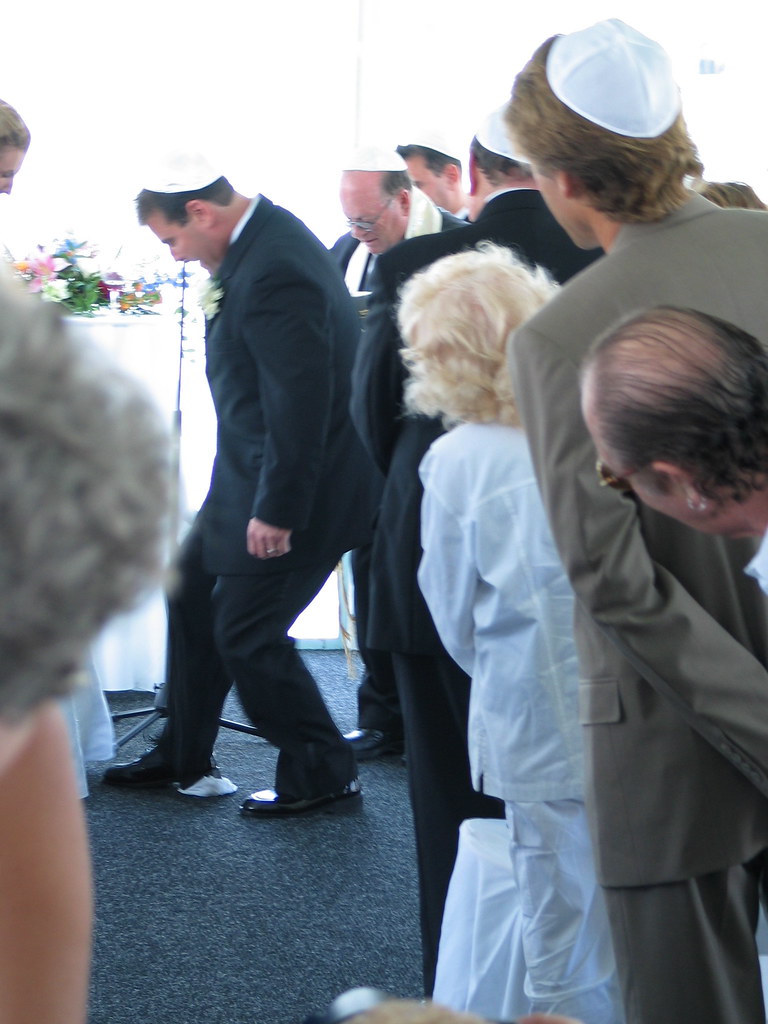
Agis provides a variety of examples of evil eye healing rituals and others histories and ethnographies provide even more, including applying salt, breathing aromatic herbs, heating and popping black seeds, and melting bits of rubber or gum. Each of these methods uses local ingredients, but linked to common themes, such as purity (salt) or redirection (popping seeds) (17). One of my personal favorite redirection methods is smashing a glass at a wedding. At the moment the wedding couple is most joyful and most vulnerable, they smash a glass to inject a moment of surprise and whoosh…the evil eye is distracted and passes them by. (18)
A quick postscript: If you happen to live near Minneapolis, MN you can get Noam Sienna to do custom Jewish henna for you. Check out his shopat http://www.hennabysienna.com/. Also, in addition to his ethnographic work, Sienna also recently publishedA Rainbow Thread, an Anthology of Queer Jewish Texts from the 1st Century to 1969 which “collects for the first time more than a hundred sources on the intersection of Jewish and queer identities.” I haven’t read it yet, but it looks awesome. You can get more info at http://noamsienna.com/a-rainbow-thread/)
In last week’s post about the Adne ha-Sadeh I talked briefly about necromancy, which is magic for speaking with the dead. The Torah is pretty clear, this is bad stuff. But the objection isn’t a rationalist one, the Torah is absolutely clear that necromantic magic works (1). Jews are just supposed to keep away from it.
There are other kinds of magic, though, that have thrived within the Jewish tradition. For the Jewish monster hunter, the place to start is with protective amulets. Amulets are written texts, sometimes cast or scribed in metal but more typically written on parchment, that include one of God’s names, or one or more angel names, or some permutation of these names, along with bits of psalms, prayers, halachic (legal) writings, and pleas for some specific form of assistance. (For a primer, see Trachtenberg‘s write up (2)).
Right now, there are a variety of amulets available from Jewish auction houses and from scribes around the world (3). This week, for example, the latest auction catalog from the Kedem Auction house in Jerusalem (4) was released. Lot 6 from the catalog is a Birkat Kohanim amulet from 18th or 19th century Italy, which is intended for the “Protection from Evil Eye and for a Mother and Her Newborn.” (5)
Birkat Kohanim Amulet – Italy, 18th/19th Century – Protection from Evil Eye and for a Mother and Her Newborn. From Kedem’s Auction Catalog 65 “Rare and Important Items, including items from the of collections of Prof. Shlomo Simonsohn and Uzi Agassi.” (5)
The Kedem auction house describes the amulet as follows
Amulet containing the verses of the Birkat Kohanim (PriestlyBlessing) “May God bless you and protect you…” and a 22 letter Holy Name, derived from the verses of the BirkatKohanim.
Kedem Auction Catalog 65 (5)
The Kedem auction catalog is worth a read. It justifies the validity of the amulet in critical two ways. First, it spends time explaining where in the Talmud Birkat Kohanim amulets were described. This is intended to show that an observant Jew can carry such an amulet. Second, it shows that the power of the amulet is “proven” by telling the story of a similar amulet. I put quotes on the word proven because it’s a loaded term in Jewish amulet lore. According to the Talmud (Shabbat 61 A) only amulets that are proven can be carried on Shabbat. There are specific rules for proving an amulet, which typically involve three demonstrations of the amulet’s power (6).
R. Kalfon Moshe HaKohen Rabbi of Djerba (Tunisia) once wrote the verses of Birkat Kohanim on a plain piece of paper, and gave it to his granddaughter as an amulet for an easy birth. The residents of Djerba regarded it as a proven amulet, and would use it as a segulah for easy birth and recovery….
Kedem’s Auction Catalog 65 (5)
This description of R. Kalfon writing the amulet talks about R. Kalfon creating a segulah. A segulah is a charm, the text that gets put on the amulet. A segulah can be used without putting it on parchment, though amulets are usually how they’re applied. Having a holy sage put the words on parchment gives it its power.
MONSTER HUNTER PRO TIPS
1. Having a connection to a holy sage who can scribe amulets is a practical necessity. If possible, a Jewish monster hunter should have amulets against demons, curses, and the evil eye. 2. Keep an amulet kit handy, in order to repair or improvise a new amulet if needed. Improvised amulets will work better if you’re taking your mitzvot (commandments) seriously and have some scribe training.
My personal amulet making kit, including kosher parchment, quills, Torah ink, and scraping tool. I am completely unqualified to use this kit, but maybe someday!
Amulets such as the Birkat Kohanim offered by Kedem aren’t that rare. They come up at auction regularly. The last few Kedem auctions have included amulets and the current auction from the Ishtar auction house has a lot of 45 of them being auctioned together. (I really really wish I could afford to bid on this!)
Large lot of approx. 45 amulets, mostly Jewish, written on paper, parchment and Gvil (leather sheet). Including amulets against the Evil Eye, curses, protection for pregnant women and the sick and more. Various sizes and conditions, overall good condition (stains, tears, wear and worming to some items). Ishtar Auction 76, Lot 105. December 5, 2019 (7)
These amulets are part of the family and religious life of Jewish communities around the world. This past spring, I was able to visit my daughter in Israel where she was studying for a semester (8). While there I visited the Israel Museum on a tour with the parents of some of the other students. At one point one of the parents, an American Jew of Persian descent and truly lovely person, got very excited and started pointing to one of the displays. Specifically, she was pointing to a metal amulet in a display on child birth. Her family had a very similar amulet and she had given birth to both of her children with the amulet on her chest. After her successful deliveries, the amulet was re-claimed by her mother who was ready to pass it along to other family members.
Replica of an 18th Century Persian Jewish amulet intended to ease childbirth. The inscription is taken from the Psalms and includes the name of Jochabed, the mother of Moses, Miriam, and Aaron. From the Israel Museum’s collection. The replica is available from the Judaica Web Store (9)









 Jewish Monster Hunting